Minister's Zoning Orders (MZOs)
February 16, 2021
TL;DR
Ford's government issued more Minister's Zoning Orders (MZOs) in 2020 alone than the McGuinty and Wynne governments combined over 15 years — bypassing environmental reviews, municipal authority, and public consultation. Nearly half of all MZOs issued in Ford's first term benefited PC donors or party insiders. Key recipients include the DeGasperis family and Flato Developments, who received nine MZOs for thousands of homes on protected farmland.
The Web
4 connections
Carmine Nigro
Received an MZO for a Craft Development project in Kawartha Lakes while simultaneously serving as VP of the PC Ontario Fund. He was seated at Ford's own table at the Ford family wedding alongside other developer guests who collectively received more MZOs than the Liberals issued over 15 years.

Mario Cortellucci
Cortellucci-controlled companies received six MZOs, more than any other single developer family. Properties in Vaughan, Innisfil, and Caledon all received fast-track approvals. Cortellucci family donations to Ford's PC leadership totalled over $12,000. He was seated at Ford's table at the Ford family wedding alongside other MZO-recipient developers.

Nico Fidani-Diker
Lobbied on behalf of developer clients seeking MZOs and Greenbelt land removals without properly disclosing the MZO component in his lobby registrations — a breach the Integrity Commissioner confirmed in five separate findings of non-compliance. Companies in which Fidani-Diker had development interests also received two MZOs. His prior role in the Premier's Office gave him direct access to the people making those decisions.
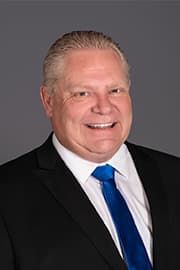
Doug Ford
As Premier, Ford's government issued more Minister's Zoning Orders in 2020 alone than the two prior governments combined over 15 years, with nearly half benefiting PC donors or party insiders.
Why It Matters
The MZO record is strikingly clear when you examine who benefited. The DeGasperis family — major PC donors whose fingerprints also appear on the Greenbelt scandal and Highway 413 corridor — received MZOs through their DG Group for a massive warehouse development in Vaughan that required destroying three protected wetlands. Flato Developments, owned by Shakir Rehmatullah, received nine MZOs — more than any other developer in Ontario — enabling over 8,000 new homes on farmland, floodplains, and rural land, overriding municipal planning decisions and conservation authority recommendations in multiple cases.
The MZO for a Pickering wetlands warehouse project became symbolic when CBC News revealed Amazon Canada was the intended tenant — days before the wetland was about to be bulldozed. Amazon withdrew, and the government eventually reversed the MZO, but only after public outcry. In Caledon, an MZO fast-tracked a new neighbourhood for a consortium of developers including Fieldgate Developments, Mattamy Homes, and Paradise Developments, all of them consistent PC donors.
Ford's government also passed Bill 257, which explicitly exempted MZOs from provincial planning laws and policies — including the Provincial Policy Statement protecting agricultural land and natural heritage. This meant MZOs could now override protections that even the Ford government's own planning rules were supposed to guarantee. Environmental Defence, Ontario Nature, and Ecojustice condemned the legislation as effectively removing any remaining constraints on the minister's power to approve whatever developers requested.
As the Greenbelt scandal unfolded in 2023, the connections between MZOs, Greenbelt land removal, and developer donor networks became increasingly clear. Many of the same developers who received MZOs had also lobbied for and benefited from Greenbelt boundary changes. The Auditor General's report on the Greenbelt scandal called out MZOs as part of the same pattern of using provincial instruments to deliver value to politically connected developers.
Legal Actions
Ford's government passed Bill 257 in 2021, which explicitly exempted MZOs from the Provincial Policy Statement and other provincial planning policies — including protections for agricultural land, natural heritage, and floodplains. Environmental Defence, Ontario Nature, and Ecojustice issued a joint statement condemning the legislation as effectively eliminating the last remaining constraints on the minister's ability to approve development anywhere in Ontario, regardless of environmental consequences.
Environmental law charity Ecojustice launched legal challenges against specific MZOs that approved development on protected wetlands, arguing the government had violated federal Fisheries Act protections and provincial environmental laws. Several challenges focused on projects where conservation authorities had explicitly rejected development applications, only to have the minister override those decisions via MZO. The cases highlighted the legal grey zone created when MZO powers were used to circumvent environmental protection statutes.
Government Activity on This File
via PoliMon · updated hourly…omment period: September 1, 2026 - October 1, 2026 (30 days) Open Request for a Minister's Zoning Order to increase the permitted size of a Place of Worship in a Residential Area The…
Rippling Effects
The MZO spree has had lasting land-use consequences. Dozens of projects that would have been rejected through normal planning processes — or that would have undergone extensive environmental review and public consultation — have been locked in by MZOs that cannot be appealed. Conservation authorities that raised objections were, in several cases, subsequently stripped of their powers through separate Ford government legislation (the More Homes Built Faster Act, 2022), further weakening the institutional checks that MZOs were already bypassing.
The pattern also demonstrated how political access translates into planning decisions in Ontario. Developers with lobbyists connected to the PC party, or with records of large donations, received MZOs quickly and with minimal public process. Developers without those connections — or projects that lacked political sponsorship — navigated the standard multi-year planning process. The result was a two-tier planning system where access to the Housing Minister's office determined outcomes.
Post-Greenbelt scandal, Ford promised reforms and review, but environmental groups and opposition parties documented continued use of MZOs to benefit connected developers, with limited transparency about how decisions were being made. The underlying power remains intact and can be revived whenever a politically convenient project needs expedited approval.