Ontario Hospital Privatization: $300M for 61 For-Profit Clinics
May 28, 2026
TL;DR
Ford directed nearly $300 million in public funds to 61 new private (majority for-profit) clinics while Ontario's public hospitals face historic underfunding — triggering one of the largest healthcare protests in Ontario history, with thousands marching at Queen's Park on May 28, 2026.
The Web
2 connections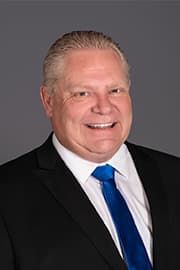
Doug Ford
As Premier, Ford directed nearly $300 million in public funds to 61 new majority for-profit clinics while Ontario's public hospitals face historic underfunding, triggering one of the largest healthcare protests in provincial history.

Andrew Longhurst
Authored the CCPA study released Sept 28, 2026, which found wait times rose for 8 of 12 priority procedures between 2017 and 2025 as for-profit clinic funding grew, and that FOI records show $659 million paid to private clinics in 2024-25 versus $84.7 million in the Public Accounts. "It's deeply alarming that so much money has been spent on for-profit surgeries and, yet, we don't have the results to show what Ontarians are getting for those dollars" (CBC).
Why It Matters
The financial logic of this policy collapses under scrutiny. The Ford government is directing public money — nearly $300 million — into private clinics that the province's own Auditor General found charge 20–200% more for the same procedures than public hospitals. Meanwhile, public hospital emergency departments closed 1,117 times in 2024, Ontario spends less per capita on hospital care than any other province, and the Financial Accountability Office projected the elimination of 7,263 nurse positions and 1,784 PSW positions by 2027–28 under Ford's spending plan. Paying more per procedure through private clinics while cutting the public system is not a cost-saving reform — it is a structural transfer of public resources to private operators.
The Ontario Health Coalition and health economists have documented the pattern clearly: systematically underfund public hospitals, allow wait lists to grow to crisis length, then direct public money to private alternatives that profit from the overflow. Ontario Health Coalition executive director Natalie Mehra described it directly: "Doug Ford is using our tax money to create an infrastructure of private, for-profit hospitals that will bring in American-style health care." The 61 clinics receiving public funding are not a supplement to the public system — they are a publicly subsidized parallel system that competes with it for staff, for procedures, and for the public dollars that would otherwise sustain hospitals.
The conflict of interest at the centre of this policy is stark. Former Ontario Health Minister Christine Elliott — who served in Ford's cabinet and oversaw health policy — subsequently registered as a lobbyist for Clearpoint Health Network, Canada's largest private surgical clinic chain. Elliott spent years shaping the regulatory and funding environment for private health delivery in Ontario. She is now paid to advocate for the company that stands to gain most directly from the policy she helped build. This is the same revolving-door dynamic that has defined Ford government procurement and contracting across multiple sectors.
The scale of public response on May 28, 2026 signals that this policy has breached a threshold. Protesters came from 14 cities — Ottawa, Kingston, Windsor, Niagara, London, and beyond — and estimates put attendance between 5,000 and 10,000 people, making it one of the largest healthcare protests in Ontario in recent memory. Healthcare is not a niche political issue — it is the thing Ontarians depend on when they are most vulnerable. The breadth and size of this mobilization reflects a population that can see what is happening to their hospitals and does not accept the government's framing of privatization as reform.
Rippling Effects
Patients diverted to private clinics face a system designed around profitable procedures rather than comprehensive care. Private surgical clinics cream-skim — they select straightforward, high-margin procedures and leave complex, expensive, or unprofitable cases to the public system. This means the patients most likely to need public hospitals are the ones whose conditions have been complicated by delayed or incomplete treatment at private facilities. The 1.2 million patient redirects the province projects are not evenly distributed across the population — they are concentrated among patients with conditions that are easy to treat profitably, while those with serious or chronic illness remain in an underfunded public system.
The volume loss to public hospitals is not a side effect of privatization — it is an existential risk. Ontario hospitals are funded partly based on patient volumes and procedure counts. As private clinics absorb 1.2 million patient interactions, public hospitals lose the associated funding, further deepening deficits that are already forcing ER closures and staff cuts. The cycle is self-reinforcing: underfunding causes capacity loss, capacity loss drives patients to private alternatives, private alternatives drain volume and revenue from public hospitals, and public hospitals become less viable. Each iteration makes the public system harder to defend politically and easier to privatize further.
The long-term trajectory of this policy, if unchecked, is a two-tier healthcare system in which access to timely care is determined by ability to pay or by employer benefits — not by need. Ontario Health Coalition's warning about "American-style health care" is not rhetorical: the United States spends vastly more per capita on healthcare than Canada while covering fewer people and producing worse outcomes, precisely because its system is structured around private profit rather than universal access. The $300 million directed to 61 private clinics is not an isolated budget decision — it is an early and visible step toward a structural transformation of how Ontarians access medical care.