Ontario Place Sewage: Ford Reroutes Raw Sewage Into Lake Ontario
December 27, 2024
TL;DR
To prepare Ontario Place for a private Austrian spa, the Ford government rerouted a raw sewage overflow pipe into the West Channel of Lake Ontario — bypassing public consultation, exempting the project from environmental review, and proceeding over the objections of physicians, landscape architects, and 2,250 Ontarians who formally opposed the plan.
The Web
6 connections
Kinga Surma
As Minister of Infrastructure, Surma oversaw Infrastructure Ontario's management of the Ontario Place redevelopment, including the construction of the combined sewer overflow reroute into the West Channel that began December 1, 2025. Infrastructure Ontario notified City of Toronto staff directly of the construction start.

Dr. Samantha Green
Led medical opposition to the Ford government's plan to reroute a combined sewer overflow pipe into the West Channel of Lake Ontario. At a December 2025 news conference, warned that contact with the water after storm events would cause diarrhea, vomiting, skin infections, and eye infections, and that pathogens "accumulate in lake sediments" and persist long after discharge stops.

Ann Elisabeth Samson
Co-led public opposition to the Ford government's plan to reroute combined sewer overflow into the West Channel. Coordinated advocacy that generated 2,250 public comments against the Environmental Compliance Approval application in early 2025 — forcing its withdrawal. Disclosed that Infrastructure Ontario had notified the City of Toronto directly of the December 1, 2025 CSO construction start.

Walter Kehm
Former design consultant on the Ontario Place/Therme redevelopment who resigned in 2023 over environmental concerns. Publicly warned that the West Channel CSO rerouting would create a "breeding ground for E. coli, Listeria and other water-borne diseases," describing the channel as "an entrapped bathtub" with inadequate water flow to disperse pathogens. His resignation and subsequent advocacy represent a documented case of a project insider raising professional accountability concerns that the province ignored.

Chris Glover
Raised the sewage issue in the legislature and at public news conferences, documenting the government's contradictions. Published Infrastructure Ontario's own RFQ that contradicted the Ministry of Tourism's claim that the CSO construction was "unrelated" to Ontario Place. Called Bill 5's elimination of public consultation on Ontario Place permits "a shocking abuse of power."
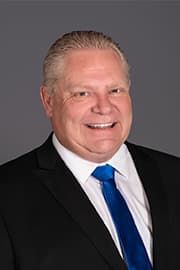
Doug Ford
As Premier, Ford's government rerouted a raw sewage overflow pipe into Lake Ontario to prepare the Ontario Place site for the Therme spa, bypassing public consultation and environmental review over the objections of 2,250 Ontarians.
Why It Matters
The sewage controversy is not a side issue of the Ontario Place redevelopment — it is the physical consequence of building a private spa on public waterfront land without a full environmental assessment. The province exempted the Therme West Island site from the Environmental Assessment Act through the Rebuilding Ontario Place Act, 2023, passed in just over a week. When the province tried to use the Environmental Registry's normal approval process for the CSO rerouting, it received 2,250 public objections and was forced to withdraw. So it changed the law instead. Bill 5 removed the public notice and comment requirements for all Ontario Place permits going forward — the government's solution to public opposition was to eliminate the public's voice.
The health risks are concrete and documented by medical professionals. Dr. Samantha Green, President of the Canadian Association of Physicians for the Environment, warned that raw sewage in the West Channel would cause "diarrhea, vomiting, skin infections, and eye infections" in anyone who contacts the water after a storm event. Pathogens, she noted, "accumulate in lake sediments" and persist long after a discharge event ends. The proposed mitigation — a turbidity curtain — is a temporary physical barrier that maintains water clarity but does nothing to eliminate bacteria or pathogens. The province's own standard for safe swimming is 100 E. coli colony-forming units per 100 mL of water; Sunnyside Beach, downstream of the West Channel, already recorded 174 CFU/100 mL in summer 2025.
The West Channel is not a remote or low-use waterway. It is used daily by the Argonaut Rowing Club, dragon boat teams, kayakers, and recreational swimmers. The channel has been a centre of competitive aquatic sport for generations. The Boulevard Club and other waterfront organizations appeared at the January 2025 news conference alongside MPPs and doctors. The proposed CSO discharge location is not far from people in the water.
The broader pattern is one of accountability structures being systematically removed. The Rebuilding Ontario Place Act exempted the project from the Environmental Assessment Act. The Therme West Island and LiveNation sites were excluded from the provincial EA's scope. Therme conducted only a voluntary environmental review of its own shoreline works — commissioned from its own consultants. When the ERO process generated mass opposition to the CSO change, the province eliminated the ERO process for Ontario Place entirely. At each decision point where normal accountability mechanisms would have slowed or stopped the project, the Ford government changed the rules.
The Supreme Court of Canada agreed in January 2026 to hear a constitutional challenge to the Rebuilding Ontario Place Act — arguing the legislation "insulates state action from scrutiny by the courts" and breaches the public trust. The SCC's decision to grant leave is significant: the Court rarely hears challenges to provincial legislation of this kind. The constitutional question — whether a government can legislate its own infrastructure projects entirely outside the reach of both courts and environmental review — remains live. In the meantime, construction on the West Channel CSO proceeds.
Legal Actions
The province posted an Environmental Compliance Approval application (ERO 019-9534) on December 27, 2024, during the holiday period, seeking approval to construct an interim combined sewer overflow at 955 Lake Shore Boulevard West with discharge into Lake Ontario. The posting received 2,250 public comments — nearly all in opposition. The comment period was extended 15 days due to "high level of public interest." The applicant withdrew the application on February 28, 2025 without an approval being issued. The Ford government subsequently passed Bill 5 in June 2025, eliminating the requirement for future Ontario Place permits to go through this public notice process.
Ontario Place for All applied for judicial review to require a full environmental assessment of the Therme West Island redevelopment before construction proceeded. A three-judge Divisional Court panel dismissed the application in June 2024, finding that the Rebuilding Ontario Place Act had validly exempted the project from the Environmental Assessment Act.
Ontario Place Protectors challenged the constitutionality of the Rebuilding Ontario Place Act, arguing it impermissibly insulates provincial action from judicial scrutiny under s.96 of the Constitution Act, 1867 and breaches the public trust doctrine. Dismissed at Divisional Court; dismissed by the Court of Appeal in March 2025 (correcting the lower court on standing). The Supreme Court of Canada granted leave to appeal on January 8, 2026 — a significant step, as the SCC rarely hears challenges to provincial legislation of this kind. A hearing date had not been set as of March 2026.
Government Activity on This File
via PoliMon · updated hourlyConsultation window: August 30, 2021 to October 28, 2021 Ontario Place redevelopment August 30, 2021 to October 28, 2021 Share your views on the Ontar…
Rippling Effects
The sewage scandal illustrates that the $2.24-billion price tag for Ontario Place is not just a financial transfer to a private company — it includes paying to restructure public infrastructure in ways that degrade public spaces. Ontario's taxpayers are funding a CSO reroute that moves sewage from a private beach to a public recreational waterway, so that Therme Group's guests can swim in clean water while everyone else deals with what was displaced. The logic is that of a subsidy: private benefit, public cost, public risk.
The communities most directly affected — people who row, paddle, swim, and gather at the West Channel and Sunnyside Beach — are exactly the communities the province cited as future beneficiaries of the Ontario Place redevelopment. The government promised a revitalized waterfront accessible to all Ontarians. What the CSO rerouting delivers is a waterfront where the private Therme beach has clean water because the overflow has been moved to where the public actually recreates. This is not a side effect of the development — it is the development's logic made visible.
The Bill 5 exemption for Ontario Place environmental approvals sets a template. The province can now build any infrastructure associated with the Ontario Place redevelopment without posting permits to the Environmental Registry, without the 30-day public comment period, and without the obligations that would otherwise trigger under the Environmental Bill of Rights, 1993. Environmental Defence, the Canadian Public Health Association, and the Ontario Public Health Association all raised alarms about Bill 5's broader implications for environmental accountability across the province — the Ontario Place exemption is a specific instance of a general attack on public participation rights.
The professional resignations from the project are a notable indicator of its conduct. Walter Kehm — a landscape architect known for designing Trillium Park and Tommy Thompson Park, both on the Toronto waterfront — resigned in 2023 saying he had become "persona non grata" for advocating on behalf of the trees, wildlife habitat, and 192 bird species present on the West Island. He later became a vocal critic of the CSO plan, calling it a public health issue. When professionals with direct knowledge of a site choose resignation over continued involvement, it signals that ordinary professional accountability mechanisms have been bypassed.
The Great Lakes dimension cannot be separated from the local one. Lake Ontario spans nearly 19,000 square kilometres and is the drinking water source for millions of Ontarians. The Canada-Ontario Agreement on Great Lakes Water Quality (2021) commits both governments to protecting the lake from exactly this kind of nutrient and pathogen loading. The Pointer's reporting flagged the federal government's absence from this controversy despite its jurisdiction over navigable waters — an accountability gap that has enabled the province to proceed without meaningful external check.