The School Lands Sell-Off
March 20, 2026
TL;DR
The Ford government passed legislation giving the Minister of Education power to force school boards to sell public land to private developers, then used manufactured financial crises to take over six school boards — handing control of an estimated $60 billion in public land to provincial-appointed supervisors with real estate backgrounds and no education experience.
The Web
4 connections
Paul Calandra
As Minister of Education, Calandra ordered the provincial takeover of six school boards in 2025 and approved the June 2025 regulation allowing the province to directly control school board property sales. He appointed real estate and finance insiders — rather than educators — as supervisors, and has put all boards "on notice" regardless of their financial standing.

Rick Byers
Appointed as provincial supervisor of the Dufferin-Peel Catholic District School Board in June 2025 — less than six months after leaving the PC caucus. As supervisor, Byers holds all powers previously held by elected trustees, including decisions about school land and property.

Rohit Gupta
Appointed by the Ford government as provincial supervisor of the TDSB in June 2025, giving him sole decision-making authority over the board — including control of the Toronto Lands Corporation, which manages $20 billion in public school land. With no education background, Gupta is working with the Ministry on undisclosed changes to how the TLC operates, while public transparency at the agency has been curtailed.
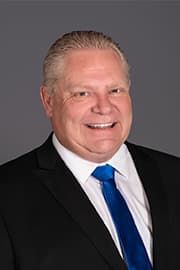
Doug Ford
As Premier, Ford's government passed legislation letting the Education Minister force school boards to sell public land to private developers, then used manufactured financial crises to take over six boards controlling an estimated $60 billion in land.
Why It Matters
Bill 98, passed in June 2023, fundamentally shifted who controls public school land in Ontario. Before the bill, decisions about selling school properties required the involvement of locally elected trustees accountable to their communities. After it, the Minister of Education gained the power to force boards to sell land not projected to be needed for students within ten years — including to private developers — without meaningful democratic input.
The 2025 school board takeovers compounded this. Rather than reverse the chronic underfunding that left boards scrambling to sell assets, the Ford government cited the resulting deficits as "mismanagement" and appointed supervisors to run the boards. The TDSB's supervisor, Rohit Gupta, is the managing partner of Harrington Place Advisors — an M&A firm that, by its own description, specializes in "identifying high value opportunities for public sector assets." He has no known experience in public education and earns $350,000 annually in the role.
By taking over the TDSB, the province also seized control of the Toronto Lands Corporation (TLC), the school board's real estate subsidiary that manages its $20 billion land portfolio. Shortly after the takeover, public meetings were no longer livestreamed and the TLC's governance documents were pulled from public access. Gupta told the TLC board in November 2025 that he was working with the Ministry on a "shareholder direction" — a fundamental change to the TLC's mandate — but declined to say what it would contain.
As NDP education critic Chandra Pasma observed, the supervisors' "only qualifications are that they are conservative insiders." MPP Peter Tabuns put it more directly, questioning whether Ford was imposing the takeover "to control the sale of real property owned by the TDSB for the benefit of his developer friends, the way he did with the Greenbelt."
Rippling Effects
Once public land is sold, it is gone. As housing researcher Mark Richardson has noted, "if we do try and get it back, it's going to be prohibitively expensive." Toronto is a rapidly growing city with a documented shortage of school space in new communities — strategic land retention is essential to building new schools where families will live. Selling off school sites to developers now means communities may face permanent shortfalls of public facilities in the future.
The TDSB had been pioneering a different model: instead of outright sales, the Toronto Lands Corporation was developing partnerships that built schools within mixed-use housing projects — keeping land public while generating community benefit. That approach is now under threat. The appointed supervisor has signalled structural changes to how the TLC operates, and both the TDSB and TCDSB are currently litigating at the Ontario Land Tribunal to resist provincial moves permitting large-scale development on school properties near transit stations.
The pattern mirrors the Greenbelt scandal in structure: use an emergency or crisis narrative to claim oversight authority, install insiders with real estate backgrounds, reduce public transparency, and quietly rewrite the rules governing what happens to the land. With an estimated $60 billion in school board land across Ontario now subject to ministerial direction, the potential scale of this transfer of public wealth to private hands is enormous.
For students and families, the immediate consequences are already visible. Two Toronto secondary schools — Eastdale and Heydon Park — have been directed to close enrollment for incoming grade 9+ students, a precursor to closure. Special education programs have had class sizes increased unilaterally. The democratic check that elected trustees once provided — the ability of local communities to push back on decisions about their schools — has been suspended indefinitely.