Conservation Authority Merger — Ford Forces 36 Local Environmental Watchdogs into 9, Overriding 14,000 Objections
March 10, 2026
TL;DR
Over the objections of more than 14,000 residents, municipalities, and environmental groups, the Ford government is forcing Ontario's 36 conservation authorities — locally funded, elected-representation bodies that manage watersheds, flood control, and natural hazards — to merge into just 9 regional bodies starting May 2026, weakening local accountability and environmental oversight at a time of escalating climate risk.
The Web
2 connections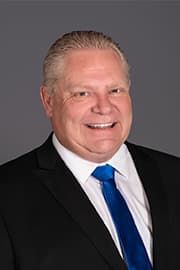
Doug Ford
As Premier, Ford advanced the forced merger of 36 conservation authorities into 9, ignoring over 14,000 public objections. The policy follows Ford's documented pattern of stripping powers from locally accountable environmental bodies — he previously gutted conservation authority review powers via Bill 229 in 2021.

Rob Flack
As Minister of Municipal Affairs and Housing, Flack is responsible for the conservation authority merger legislation and pushed it forward in March 2026 despite widespread opposition from municipalities, environmental groups, and even the Ontario Federation of Anglers and Hunters.
Why It Matters
Conservation authorities are the primary front-line environmental review body for most Ontario development applications. They perform flood mapping, permit review for development near waterways, natural hazard mapping and assessment, and watershed restoration. Their expertise is built over decades of local monitoring — they know which creek bends flood, which karst formations exist beneath specific parcels, which seasonal wetlands appear on no satellite image. Stripping that local expertise by administrative fiat is not a technocratic reorganization; it is the removal of the one body capable of saying no to a specific development for site-specific hydrological reasons. The Narwhal documented the full scope of what conservation authorities actually do and what will be lost in the transition.
The mega-region problem is not abstract. The proposed Huron-Superior authority would span 1,400 km across 78 municipalities whose geological contexts share almost nothing in common — the north shore of Lake Huron and the Bruce Peninsula have entirely different soils, drainage regimes, and flood-risk profiles. The Ontario Federation of Anglers and Hunters — not a typical environmental advocacy group — formally opposed the plan alongside environmental organizations, signalling that the objections crossed the usual political divides. Over 14,000 public objections were formally filed through the government's own consultation process and ignored entirely. The Pointer reported that the government moved forward without addressing a single substantive concern from the consultation record.
This merger is the next step in a documented deregulation pattern. Ford previously stripped conservation authority powers in 2021 via Bill 229, removing their ability to review development on natural hazard grounds. Fewer bodies means less capacity to scrutinize individual projects — and Environmental Defence warned explicitly that concentrating power into 9 bodies creates a single point of capture for political influence. Where 36 independent bodies once had to be individually influenced or pressured, 9 directors are practically capturable. That risk connects directly to Bill 5's deregulation agenda and the broader rollback documented in the Endangered Species Act repeal. National Observer documented the political context behind the consolidation push.
Environmental Defence's warning about a single point of capture is not rhetorical — conservation authority directors currently represent diverse municipal constituencies across dozens of communities. Nine mega-bodies have nine director boards that are practically reachable by any well-resourced developer seeking province-wide regulatory uniformity. No other provincial jurisdiction has fewer environmental gatekeeping bodies for a geography of Ontario's size and complexity. The merger exemplifies the same discretionary-power pattern as Ford's pattern of bypassing democratic oversight: the minister decides the new boundaries, no independent criteria govern the decision, no oversight body reviews the outcome, and no reversal mechanism exists.
Rippling Effects
Consolidation takes effect May 2026 with a $20 million transition budget — critics note this understates actual transition costs and says nothing about ongoing capacity losses. During the transition period, staff with decades of local watershed expertise will leave: not all will relocate to new regional headquarters, and institutional knowledge built over careers of site-specific monitoring does not transfer in an org chart. The $20 million figure covers administrative restructuring, not the replacement of expertise that will simply walk out the door.
Reduced conservation authority capacity arrives at the worst possible time. Ontario faces increasing flood risk and extreme precipitation events, and conservation authorities are among the few remaining bodies that can flag species-at-risk habitat during development review — a role that matters more now that the Endangered Species Act was repealed on March 30, 2026, removing provincial habitat protections entirely. With both the ESA and functional conservation authority oversight weakened simultaneously, the ecological review capacity that once existed at multiple levels has been stripped at every level at once. The Narwhal documented the final consolidation plan and its $20 million cost estimate.
No reversal mechanism exists. Once authorities are merged and municipal tax boards reorganized, institutional knowledge — decades of local watershed data, species inventories, flood-risk maps built through site-specific observation — will be dispersed or discarded. The government provided no plan for preserving this institutional memory and no criteria for evaluating whether the new mega-bodies are actually performing the functions they replace. The merger exemplifies the same discretionary-power pattern as Bill 5: the minister decides, no criteria, no oversight, no undo.