LANDinc Ontario Place Bid Disqualification
July 2, 2026
TL;DR
Doug Ford personally asked to see an architecture firm's 3D model of Ontario Place mid-procurement — then his government's agency disqualified the firm for talking to him.
The Web
2 connections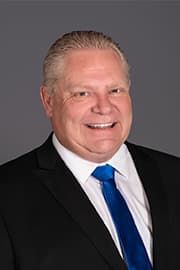
Doug Ford
As Premier, Ford has personally championed the Ontario Place redevelopment; his government ran the procurement process in which LandInc's bid was disqualified.

Jessica Smith Cross
Reported The Trillium's August 10, 2026 story on the Divisional Court's dismissal of LANDinc's judicial review, and summarized it publicly: "The Divisional Court dismissed LANDinc's application for judicial review of its disqualification from an RFP due to the premier's viewing of the company's 3D model of Ontario Place." The article itself is paywalled; the dismissal is confirmed via the headline and her own summary.
Why It Matters
Procurement anti-lobbying rules exist for one reason: to stop politicians from tilting the playing field. According to court filings reported by The Trillium, it was Doug Ford himself who initiated the contact — after a junior LANDinc employee mentioned the firm's Ontario Place model at a social event, Ford directed his office to arrange a visit, and on May 26, 2026 he toured the firm's office to see it. The RFP for Ontario Place public-realm consulting work was live at the time.
Then Infrastructure Ontario disqualified LANDinc, citing the rule prohibiting bidders from contacting MPPs — including the premier — during a procurement. Per the filings, the firm that hosted a visit requested by the premier's own office paid the price, while the premier faced no consequence at all. A junior employee at a mid-sized architecture firm is not positioned to refuse the Premier of Ontario, and according to the firm's court application as reported by TorontoToday, Infrastructure Ontario officials had themselves viewed the same model on May 6 — twenty days before Ford's visit.
This lands on a redevelopment already saturated with fairness questions. The Therme spa deal handed the West Island to a private operator on terms the auditor general found wanting; the Science Centre closure was engineered to serve the same redevelopment; and the province has moved aggressively to control the surrounding waterfront through the waterfront power grab. The LANDinc disqualification, as alleged, suggests the premier's personal involvement reaches down even into individual consulting procurements on the site.
The matter is now before the Divisional Court, where LANDinc is seeking to quash the disqualification and to enjoin Infrastructure Ontario from picking a winner in the meantime. Whatever the outcome, the core facts alleged in the filings — a mid-procurement visit requested by the premier's office, followed by the disqualification of the visited bidder — describe a procurement integrity failure that originated at the very top.
A few details from the origin reporting on the court filings are worth stating precisely. The firm's legal name is LAND Design Incorporated (LANDinc). It filed its application in Divisional Court in late June 2026 — "last week" as of the July 3, 2026 article — seeking to quash its disqualification. The employee who met Ford is described only as a junior employee; no LANDinc principal is named in the court coverage. LANDinc alleges that Infrastructure Ontario officials themselves viewed the 3D model on May 6 — during the RFP period and before the social event at which Ford was told about it.
The stakes are not small: Infrastructure Ontario recently projected that $200 million to $499 million will be spent on the Ontario Place public realm work. The premier's office told The Trillium that "Neither the premier nor his staff would have any knowledge of a proponent's involvement in an active procurement process." That assurance sits awkwardly beside the same site's procurement history: in 2024 the auditor general criticized the procurement of Therme as anchor tenant as "not fair, transparent or accountable to all participants."
Legal Actions
In late June 2026 — the reporting says only "last week" of a July 3, 2026 story, so roughly June 22-27; the exact filing date is unknown — LANDinc filed a Divisional Court application for judicial review seeking to quash Infrastructure Ontario's decision disqualifying the firm from the Ontario Place public-realm consulting RFP, along with a motion for an injunction preventing the agency from selecting a winning bidder. The firm argued the disqualification was unreasonable because contact with Premier Doug Ford was initiated at Ford's own request, and because Infrastructure Ontario officials had themselves viewed the firm's 3D model on May 6, 2026. The company also claimed Ford discussed building a convention centre "on the water west of the Therme project" with its representatives.
The Divisional Court dismissed the application. The Trillium's Jessica Smith Cross summarized the outcome publicly: "The Divisional Court dismissed LANDinc's application for judicial review of its disqualification from an RFP due to the premier's viewing of the company's 3D model of Ontario Place."
Unverified: the exact decision date is unknown — it was on or before August 10, 2026, the reporting date. The Trillium article is paywalled and its body was not read; the dismissal is confirmed via the headline and the reporter's own public summary. No appeal had been reported as of August 30, 2026.
Government Activity on This File
via PoliMon · updated hourlyConsultation window: August 30, 2021 to October 28, 2021 Ontario Place redevelopment August 30, 2021 to October 28, 2021 Share your views on the Ontar…
Rippling Effects
The immediate effect is judicial scrutiny of Infrastructure Ontario's procurement practices. LANDinc's Divisional Court application asks a court to review how the agency applied its own conflict rules — including, per the filings, why contact initiated by the premier's office was attributed to the bidder, and why the agency's own May 6 viewing of the same model was treated differently. An injunction, if granted, could freeze the award of the Ontario Place public-realm consulting contract entirely.
The chilling message to bidders is hard to miss. If, as alleged in the court filings reported by The Trillium, a firm can be thrown out of a procurement because the premier asked to visit it, then every firm doing business with the province now has to treat any contact with government — even contact it did not seek — as a potential disqualification risk. That asymmetry punishes bidders for the conduct of politicians and gives well-connected incumbents who know how to manage such contact quietly yet another advantage.
It also deepens the credibility problem around the entire Ontario Place redevelopment. A project already carrying the Therme lease controversy and the forced relocation of the Science Centre now has a court case alleging that its procurement process was compromised by the premier's personal curiosity. Each new fairness question makes it harder for the government to claim the redevelopment is being run at arm's length — and easier for future litigants to argue it never was.