Ontario School Board Corporatization
April 13, 2026
TL;DR
The Ford government has tabled Bill 101 — the Putting Student Achievement First Act — replacing elected directors of education with CEOs requiring business credentials, gutting trustees' budget and bargaining powers, and mandating government-approved lesson plans in every classroom, while education unions warn it is a roadmap to corporate control of Ontario's public schools.
The Web
6 connections
Paul Calandra
As Minister of Education, Calandra tabled Bill 101 (Putting Student Achievement First Act, 2026) on April 13, 2026, abolishing the position of Director of Education and replacing it with a CEO requiring business credentials, capping trustees at 12 per board, removing trustees from collective bargaining, mandating government-approved classroom resources, and granting the minister new powers to restrict board political speech and override capital projects.

Chandra Pasma
As NDP Shadow Minister for Education, Pasma has been the primary legislative opponent of Bill 101, publicly condemning the bill as "Ford government's heavy-handed school takeover" and warning that replacing directors with business-credentialed CEOs sets the stage for education privatization. Her critiques are documented by the Ontario NDP and widely cited in news coverage.

Martha Hradowy
As OSSTF president, Hradowy publicly condemned Bill 101 on the day of its tabling, warning that replacing directors of education with CEOs requiring business credentials signals "troubling corporatization" of public education, and calling the broader restructuring an unprecedented level of government interference in Ontario's education system.
Doug Ford
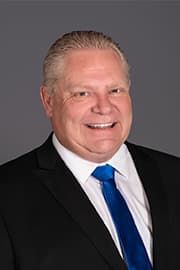
As Premier, Ford's government tabled Bill 101, replacing elected education directors with business-credentialed CEOs and mandating government-approved lesson plans, which education unions warn is a roadmap to corporate control of public schools.

Lyra Evans
As an elected trustee at a board placed under provincial supervision, Evans has been directly affected by the Ford government's education governance overhaul and publicly advocated for the preservation of elected trustee roles in response to Bill 101 and its predecessor legislation.

David Mastin
As ETFO president, Mastin led the union's public rejection of Bill 101 on April 13, 2026, describing it as "an unprecedented rollback of local democracy" and warning that the mandatory government-approved resources mandate and CEO governance structure represent a roadmap toward privatizing Ontario's public education system.
Why It Matters
Bill 101 is the legislative endpoint of a strategy that began in 2018: underfund boards until they run deficits, seize them on "public interest" grounds using Bill 33's sweeping new powers, and then restructure them permanently so that ministerial control is baked into the institution regardless of who wins the next election. The bill abolishes the title of Director of Education — the senior educational professional at every Ontario school board — and replaces it with a Chief Executive Officer who is required to have a business background, not an education background. The CEO leads budget development, and can only be dismissed with ministerial approval. A subordinate Chief Education Officer handles pedagogy but is appointed by the CEO, not the board.
Elected trustees, who historically set board direction and held administrators accountable to communities, are reduced to a yes/no vote on budgets they cannot modify. The Toronto District School Board is cut from 22 trustees to 12 — nearly halved. Trustee honorariums are capped at $10,000, and discretionary expenses for conferences and travel are eliminated. Most consequentially, trustees are removed entirely from collective bargaining for English public and Catholic boards. Provincewide labour negotiations will now flow through the Council of Ontario Directors of Education (CODE), designated as the central employer bargaining agent — a body that answers to the minister, not to communities.
The classroom is not exempt. The bill mandates that teachers use government-approved lesson plans, teacher guides, and digital tools, raising immediate concerns about academic freedom and the role of commercial education vendors in shaping what Ontario students are taught. ETFO president David Mastin described the bill as "an unprecedented rollback of local democracy," warning that "families deserve trustees who are democratically elected to make decisions, not CEOs with business credentials installed to manage public education like a corporate enterprise."
The minister also gains new authority to issue policies restricting what board representatives — a term that covers staff and executives, not elected trustees personally — can say in public about "divisive political discussions." This provision creates a structural chill on any board that might publicly oppose government education priorities. Combined with the capital project override power — which allows the minister to cancel or redirect school construction and renovation projects without full board oversight — Bill 101 ensures that the money, the buildings, the workforce, and the curriculum are all ultimately controlled by Queen's Park.
Education critics note that the NDP's Chandra Pasma has called the bill "locking parents out of being able to have a say about their kids' education," and that OSSTF president Martha Hradowy warned that "replacing directors with CEOs with no education experience signals troubling corporatization." The bill follows Bill 98 (2023), which gave the minister power to force school land sales to developers, and Bill 33 (2025), which enabled the wave of board takeovers — together representing the most sustained assault on democratic education governance in Ontario's history.
Rippling Effects
The CEO structure creates a new class of accountability: school board executives who answer to the minister for their jobs. Because the CEO cannot be dismissed without ministerial approval, boards that elect trustees opposed to government priorities will find themselves unable to remove an administrator who serves the minister's interests rather than the community's. This is not a theoretical concern — it is the institutional design of Bill 101. The same dynamic applies to the CEdO, who is appointed by the CEO and not the board, meaning educational leadership at every Ontario school board ultimately flows from Queen's Park.
The mandatory government-approved learning resources provision opens Ontario's classrooms to commercial influence at scale. Vendors whose materials receive government approval gain access to over two million students. There is no requirement for transparency about which companies' products are approved, what criteria are used, or what financial relationships exist between vendors and the ministry. Global News reported that the bill's resource mandate covers lesson plans, teacher guides, digital interactive tools and games — a substantial commercial market.
The capital project override power in Bill 101, combined with the ministerial authority over school land sales established in Bill 98 (2023), creates an institutional pathway for public school property to move toward private use. With CEO-led boards constrained by ministerial oversight and trustees unable to independently block or modify capital decisions, the democratic safeguards that would otherwise protect public school buildings and land are substantially weakened. This concern is particularly acute given the government's existing track record on the school lands sell-off.
Collective bargaining in Ontario education is now effectively centralized at the provincial level through CODE. Local boards lose the ability to negotiate local agreements independently — all provincewide terms flow through a body accountable to the minister. This represents a significant shift in labour relations that education unions have warned will make it harder to address local conditions and will concentrate power over working conditions in the hands of the government rather than local communities.
The political speech restriction provision sets a precedent that extends beyond education. If a minister can instruct publicly funded institution executives to avoid "divisive" topics, the same logic can be applied to hospitals, universities, municipalities, or any other democratically governed public body. The provision does not apply to elected trustees personally — but they have already been stripped of most of their power. Bill 101's long-term consequence may be less about what happens to school boards and more about what it establishes as acceptable tools for any government seeking to control publicly funded institutions.