Speed Camera Ban — Ignoring Evidence to Protect Speeding Politicians
September 25, 2025
TL;DR
Ford's government legalized speed cameras in 2019, then banned them in 2025 — ignoring peer-reviewed evidence that they cut school-zone speeding by 45% — after his own cabinet ministers' vehicles racked up 23 speed camera tickets and hit stunt-driving speeds.
The Web
4 connections
Prabmeet Sarkaria
As Minister of Transportation, Sarkaria was the lead minister defending the province-wide speed camera ban. He dismissed peer-reviewed evidence from SickKids/TMU showing cameras reduced speeding by 45% in school zones, rejected compromise proposals from 22 mayors and the Ontario Association of Chiefs of Police, and oversaw the implementation of Bill 56's camera prohibition.

Andrea Khanjin
As Minister of Red Tape Reduction, Khanjin tabled Bill 56, the omnibus legislation that banned speed cameras province-wide. By bundling the camera ban into a broader 'red tape reduction' bill, the government limited focused debate on the public safety implications of removing proven life-saving technology from school zones.

Steven Del Duca
Del Duca introduced the enabling ASE legislation as Liberal Transportation Minister in 2017, then as Vaughan mayor scrapped his own city's camera program in September 2025 under Ford's pressure. Ford praised Del Duca and used a Vaughan press conference to announce the province-wide ban. Del Duca's reversal provided Ford political cover for the ban — demonstrating that even the politician who created the program now opposed it.
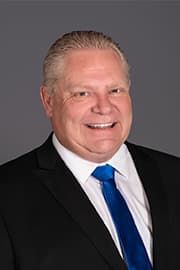
Doug Ford
Ford's government authorized speed cameras in 2019, then Ford personally led the campaign to ban them in 2025. He called them a 'cash grab,' rejected compromise proposals from 22 mayors and police chiefs, and fast-tracked Bill 56 through the legislature. His own cabinet ministers' vehicles were caught by speed cameras 23 times — including stunt-driving speeds of 162 km/h — and the government refused to identify who was driving.
Why It Matters
In December 2019, Doug Ford's government finalized the regulations that allowed Ontario municipalities to deploy automated speed enforcement cameras in school zones and community safety zones. Ford's own transportation minister praised the cameras as "an important way for local officials to reduce speeding." By 2025, more than 700 cameras operated in 40 municipalities across the province, generating tens of millions in revenue while — according to a peer-reviewed study from SickKids and Toronto Metropolitan University — reducing speeding by 45% in 250 Toronto school zones. Vehicles exceeding the limit by 20+ km/h dropped by 88%.
Yet in September 2025, Ford abruptly reversed course, calling the cameras a "cash grab" and a "tax grab." He announced a province-wide ban from a press conference in Vaughan, alongside Mayor Steven Del Duca — who had introduced the enabling ASE legislation as a Liberal minister in 2017, only to scrap his own city's cameras under Ford's pressure. Ford's government fast-tracked Bill 56 through the legislature as an omnibus "red tape reduction" bill, giving municipalities just two weeks to dismantle programs they had spent years building. He rejected compromise proposals from 22 mayors, dismissed pleas from Ontario school boards, and overrode the Ontario Association of Chiefs of Police, who called ASE "a proven life-saving technology."
The timing was particularly damning. In October 2025, Global News revealed that vehicles assigned to Ford's own cabinet ministers had been caught by speed cameras more than 23 times over three years, and that at least one government vehicle had hit stunt-driving speeds of 162 km/h — 12 separate times. The government refused to identify which ministers or staff were responsible, citing "safety."
The consequences are severe and measurable. Toronto faces the loss of roughly 1,000 jobs — including 911 crossing guards and 18 traffic safety police officers whose salaries were paid directly from speed camera revenue. The city estimates replacing cameras with speed bumps and traffic-calming measures will cost $52 million and take 13 years. Ford's $210 million provincial road safety fund, divided among all affected municipalities, falls far short. Meanwhile, the SickKids study showed that when cameras are removed, speeding rates immediately return to pre-intervention levels.
Legal Actions
Toronto City Council unanimously passed a motion urging the Ontario government to reimburse the city for the costs of crossing guards and traffic safety police officers whose salaries had been funded by speed camera revenue. The motion cited the loss of approximately $40 million in annual revenue and the potential layoff of roughly 1,000 workers, including 911 crossing guards. The provincial government has not responded to the request.
Rippling Effects
The most immediate ripple effect is a massive unfunded mandate on municipalities. Toronto alone was collecting roughly $40 million annually from its ASE program, which directly funded crossing guards, traffic safety officers, and road safety infrastructure. With that revenue stream eliminated overnight, cities face an impossible choice: cut safety programs, raise property taxes, or simply leave school zones unprotected during the years-long infrastructure buildout Ford has prescribed as an alternative.
Ontario's road safety gains are already at risk of reversal. The SickKids/TMU study demonstrated unequivocally that speeding rates return to baseline the moment cameras are removed. Traffic-calming measures like speed bumps, while effective on residential streets, cannot be deployed on arterial roads where many school zones sit, are problematic for snow removal and emergency vehicle access, and require massive capital investment. The $52 million and 13 years Toronto estimates for replacement infrastructure underscores the gap between Ford's prescription and reality.
The ban also sets a troubling precedent for provincial overreach into municipal governance. Ontario municipalities invested years and millions of dollars building ASE programs that were explicitly authorized by Ford's own government. The ban, pushed through as part of an omnibus bill with limited debate, effectively stripped cities of a tool they were told they could use. It joins a pattern of Ford government actions — including the removal of bike lanes (Bill 212), the override of municipal land-use decisions, and centralization of power through the Strong Mayors Act — that concentrate power in Queen's Park at the expense of local democratic decision-making.
The political calculus is revealing. Public polling from Angus Reid showed 49% of Ontarians opposed the ban versus only 38% who supported it. The only demographic group showing majority support was men over 54. Ford's decision appears driven not by evidence or popular demand, but by a populist anti-regulation instinct — and, perhaps, by the personal experience of his own government's drivers, who were caught speeding at alarming rates and refused to be publicly identified.