Ford's Gravy Plane — $28.9M Jet Bought Without Competitive Tender
April 17, 2026
TL;DR
Doug Ford spent $28.9 million in taxpayer money on a private jet — then reversed the decision 48 hours later after a public backlash, announcing the province would sell the aircraft "as quickly as possible." Ford made no reference to his 2019 boast that he was the only premier in history to refuse a government plane, and the financial cost of the reversal — including any cancellation penalties or resale loss — has not been disclosed.
The Web
3 connections
Norman Di Pasquale
As Chair of NoJetsTO, Di Pasquale was among the first to publicly connect the Ford government's $28.9M jet purchase to its forced Billy Bishop expansion — noting that the Challenger 650 cannot operate from downtown Toronto without the runway extension Ford is forcing through over community and City of Toronto opposition.
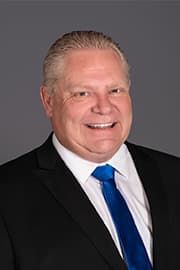
Doug Ford
As Premier of Ontario, Ford is the primary beneficiary and decision-maker behind the $28.9 million Challenger 650 purchase. Ford publicly boasted in 2019 that he was "the only premier in history" to refuse government aircraft — selling Ontario's existing King Air turboprops — before buying an executive jet for nearly three times the combined cost of the aircraft he refused to use.

Prabmeet Sarkaria
As Ontario's Minister of Transportation, Sarkaria holds the portfolio covering aviation and transportation infrastructure — including the Billy Bishop Airport expansion that would enable jet operations from downtown Toronto. His ministry's mandate directly overlaps with both the jet purchase and the waterfront airport seizure announced months earlier.
Why It Matters
In 2019, Doug Ford made a point of publicly refusing to use Ontario's government-owned Beechcraft King Air turboprop, calling it wasteful and declaring himself "the only premier in history" to reject the perk. Seven years later, his government has quietly purchased a pre-owned 2016 Bombardier Challenger 650 for $28.9 million — an executive jet capable of carrying 12 passengers across 7,400 kilometres — without a competitive procurement process, without disclosing which ministry authorized and paid for it, and without providing any estimate of the aircraft's annual operating costs, which industry benchmarks put at roughly $3 million per year.
The announcement arrived on April 17, 2026, less than two months after Ford declared Billy Bishop Toronto City Airport Ontario's first Special Economic Zone and announced plans to seize the City of Toronto's land stake in order to expand the airport's runway to accommodate jets. The government states the new aircraft will operate out of Pearson International Airport — but critics point out that without the Billy Bishop expansion, the Challenger 650 cannot operate from downtown Toronto. Ford is simultaneously buying the jet and forcing through the expansion that would let him fly it from the most convenient airport in the city. NoJetsTO Chair Norman Di Pasquale stated: "The timing of Ford's purchase of his taxpayer funded 'Gravy Plane' and his sudden interest in expanding the island airport is not a coincidence."
All three opposition parties condemned the purchase. NDP Leader Marit Stiles coined the phrase "gravy plane," inverting Ford's own "gravy train" rhetoric. The Canadian Taxpayers Federation called it "completely unacceptable" given that Ontario is adding $25.8 billion to its debt this year while paying over $1 billion monthly in interest charges. Premier Ford is not the first Ontario PC leader to make this mistake: Premier Bill Davis purchased a Bombardier Challenger in 1981 for $10.6 million and sold it 14 months later under near-identical opposition pressure. Ford has now repeated the same pattern for nearly three times the price.
The procurement process — or absence of one — raises its own questions. The jet was purchased directly from Bombardier, with no public competitive bidding reported. Ontario's procurement rules require competitive processes for large government purchases, with sole-source exemptions requiring documented justification. None has been published. The government has not disclosed which ministry holds the asset, who authorized it, or what, if any, procurement exemption was invoked. Global News reported that a senior government official confirmed the purchase only "confidentially" — the formal public disclosure came through media inquiry, not government announcement.
Rippling Effects
The operating cost question is unresolved and the government intends to keep it that way. At industry-standard rates for a Challenger 650 flying approximately 450 hours annually, taxpayers can expect to pay roughly $3 million per year on top of the $28.9 million purchase — in crew salaries, fuel, maintenance, insurance, and hangar fees at Pearson. Over a 10-year service life, the total public cost of this aircraft could approach $60 million. The government's refusal to provide any cost estimate is itself a disclosure failure, and a Freedom of Information request targeting the purchasing ministry, the procurement file, and any internal cost-benefit analysis is the most direct accountability path available.
The Billy Bishop entanglement creates a layered conflict of interest. Ford's government expropriated City of Toronto land at Billy Bishop in order to expand the airport's runway for jets — a decision that overrides a tripartite agreement signed in 1983 and blocks approximately 14,000 planned homes in Toronto's Portlands. The government currently states the new jet will operate from Pearson. But if, after the expansion is complete, the jet moves to Billy Bishop — a downtown airport minutes from Queen's Park — the entire seizure will be recast not as an economic development decision but as a personal logistics decision made at enormous public cost to Toronto's waterfront residents.
Flight log records are the next accountability frontier. In August 2023, OPP flight logs showed Ford's government aircraft routed to Buttonville Airport before travelling to FordFest in Windsor — a PC Party event. Ford's family cottage is on Fawn Lake, Port Sydney, Muskoka, near Muskoka Airport (YQA). Whether the new Challenger 650 is used for similar routing — including landings at Muskoka Airport in apparent service of the Premier's cottage commute — will be visible through flight tracking and FOI requests targeting OPP aircraft manifests once the jet becomes operational.
The broader pattern is one of accountability erosion on multiple fronts simultaneously. Ford's government attempted to permanently exempt itself from freedom-of-information requests retroactive to 1988. It has built the most aggressive government advertising machine in Ontario history. It has prorogued the legislature to avoid accountability. It bought a $29 million jet without competitive tender, without disclosing the purchasing ministry, and without estimating the ongoing cost to taxpayers — and then declined to explain any of it. Each decision individually has an excuse. Together, they describe a government that has concluded it does not need to answer to the public for how it spends public money.