FIPPA Overhaul — Ford Makes All Premier and Cabinet Records Permanently Secret
March 13, 2026
TL;DR
The Ford government buried amendments inside the 2026 Budget Bill that would permanently exempt the Premier, all cabinet ministers, and their staff from freedom-of-information requests — retroactive to 1988 — nullifying every pending FOI request and active court case, including those seeking Doug Ford's personal cellphone records and Greenbelt-related emails. Ontario's own privacy watchdog publicly called three of Ford's stated justifications factually incorrect.
The Web
12 connections
David Piccini
Then-Minister of Environment, Conservation and Parks; held a 2021 virtual meeting with unregistered lobbyist John Mutton about land later removed from the Greenbelt, documented in one of the 219 records the province's FOI changes now block release of.

John Mutton
Former Mayor of Clarington and unregistered lobbyist; met with then-Minister David Piccini in 2021 about land later removed from the Greenbelt. Later banned from lobbying Ontario until April 2027.

Ryan Amato
As former chief of staff, Amato's personal-account emails about the Greenbelt land removals are subject to an IPC order requiring disclosure. The retroactive FIPPA amendments would nullify that order, permanently shielding his records from public scrutiny.
Patrick Sackville
As former Chief of Staff, Sackville's personal-account emails about the Greenbelt land removals are among the records subject to IPC proceedings. He told the Integrity Commissioner he did not use personal email for government business — a claim contradicted by documentary evidence uncovered by Global News. The retroactive FIPPA amendments would permanently shield those communications from public scrutiny.

Mike Schreiner
Schreiner was among the loudest legislative critics of the FIPPA overhaul. He issued a statement calling the Ford government's scheduling of a rare late-night sitting on April 22, 2026 a deliberate attempt to "ram the bill through while nobody was watching." He said: "Doug Ford thinks he's above the law — and he clearly has something to hide."

John Fraser
Fraser opposed Bill 97's FIPPA changes throughout the legislative process, calling for full public hearings that were denied. He stated that changing the law retroactively suggests "there must be something really bad on your cell phone." The Liberals promised to undo the changes if elected.

Marit Stiles
Stiles led the NDP's opposition to the FIPPA overhaul in the legislature. She stated: "The only person Doug Ford is protecting is himself" and "These changes are about one thing: giving Doug Ford more power to hide their shady dealings from the public."
Dean Beeby
Beeby has been one of the leading expert voices documenting and challenging the Ford government's FIPPA overhaul. He publicly dismissed Ford's stated cybersecurity and national security justifications as a "straw man argument," noting that FIPPA already contains national security exemptions that would cover the China espionage scenario the government cited.
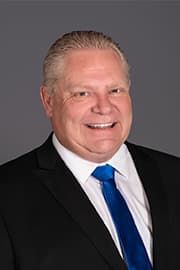
Doug Ford
As Premier of Ontario, Ford is the primary beneficiary of the FIPPA overhaul — his personal cellphone records, used for government business, were the immediate subject of a December 2025 court ruling that upheld an IPC order for disclosure. The retroactive FIPPA amendments would nullify that ruling and permanently shield his communications from public scrutiny.

Stephen Crawford
As Minister responsible for FIPPA, Crawford announced and tabled the amendments that would permanently exempt the Premier and all cabinet ministers from FOI requests, retroactive to 1988.

Patricia Kosseim
As Information and Privacy Commissioner, Kosseim publicly disputed the Ford government's rationale for the FIPPA overhaul, fact-checking three of the Premier's stated justifications and warning the amendments would paradoxically increase cybersecurity risk by pushing officials to personal devices.

Peter Bethlenfalvy
As Finance Minister and sponsor of Bill 97 (the Plan to Protect Ontario Act, Budget Measures, 2026), Bethlenfalvy is responsible for the omnibus legislation that contains the FIPPA amendments permanently exempting the Premier and all cabinet ministers from FOI requests, retroactive to 1988. The bill passed Third Reading on April 23, 2026.
Why It Matters
The FIPPA amendments were not introduced as standalone legislation — they were buried inside the 2026 Budget Bill, an omnibus measure that limited the scrutiny any single committee or affected group could mount before hearings closed. Global News reported that the changes would permanently exempt the Premier, all cabinet ministers, parliamentary assistants, and their staff from freedom-of-information requests, retroactive to 1988 — the year the original act was passed. Burying a sweeping accountability rollback inside a budget bill is not incidental; it is a deliberate procedural choice designed to minimize public and opposition scrutiny of legislation that directly benefits the people passing it.
The retroactivity is the most legally aggressive element. The amendments would not just shield future records — they would nullify every active and pending FOI request reaching back to 1988. That includes a December 2025 court ruling upholding an IPC order requiring disclosure of Doug Ford's personal cellphone call logs used for government business, and an IPC order requiring former chief of staff Ryan Amato to hand over Greenbelt-related emails sent from his personal accounts. These are not abstract future proceedings — these are specific, active accountability mechanisms that the amendments are designed to terminate. National Observer documented how the amendments would affect the ongoing Greenbelt scandal proceedings and the broader pattern of Freedom of Information obstruction documented across this government.
Information and Privacy Commissioner Patricia Kosseim published a formal rebuttal fact-checking three specific Ford government justifications. First, the government claimed 75,000 FOI requests are filed in Ontario annually — the actual figure is approximately 27,000. Second, the government claimed only media outlets file FOI requests — the IPC's data shows 96% of requests come from businesses and individuals. Third, the government claimed the changes would align Ontario with other provinces — the IPC said the proposal would make Ontario one of the most secretive governments in the country. Beyond the three false statistics, the IPC also identified a cybersecurity paradox at the heart of Ford's stated rationale: the government argued that keeping records on personal devices improves cybersecurity, but the IPC noted that personal devices are less secure than government systems, not more. The IPC's formal statement is a direct public contradiction of the government's own stated reasoning, from the office constitutionally responsible for enforcing the act.
The code-word context matters here. The Ford government previously used "G*" as an internal code word for "Greenbelt" in emails specifically to prevent those records from appearing in FOI keyword searches — a deliberate obstruction tactic documented during the Greenbelt scandal investigation. Under the FIPPA amendments, that pattern of obstruction would receive permanent legislative protection. Beyond the Greenbelt, active FOI battles over Skills Development Fund records — covering hundreds of millions in government grants to politically connected recipients — would be retroactively shielded. National Observer reported on how the IPC's formal rebuttal connected the amendment's real-world impact to the specific accountability proceedings the government was seeking to terminate.
Rippling Effects
Every other active scandal's pending FOI requests would be permanently shielded by the retroactive exemption. The Greenbelt scandal proceedings — including the IPC order requiring Ryan Amato to produce personal-account emails — would be nullified. Active FOI battles over Skills Development Fund grants to connected recipients would be terminated. Pending requests related to Minister's Zoning Orders issued to politically connected developers would be retroactively immune. The 1988 retroactivity date is not a technical formality — it means every record created by every Premier and every cabinet minister over nearly four decades becomes permanently unreachable by the public, journalists, or the courts.
Ontario would become more secretive than any other province in Canada. The IPC stated plainly that the proposal would place Ontario in a minority of the most secretive jurisdictions globally — not just among Canadian provinces. The ongoing court cases brought by the Globe and Mail and CBC seeking Ford's personal cellphone call logs, which a December 2025 court ruling already upheld as disclosable, would be terminated with no remedy available to the plaintiffs. The Globe and Mail reported that advocates and legal experts described the amendments as the most significant single rollback of public access rights in Ontario's history. Journalists and the public would permanently lose freedom of information as a tool for investigating the executive branch of government.
The IPC's cybersecurity warning carries a systemic implication beyond this specific scandal: if officials believe their personal devices are exempt from accountability, they will increasingly use personal devices for government business — creating precisely the security risk the government claims to be solving. The pattern here mirrors Bill 5, where retroactive changes were engineered to shield past decision-making from scrutiny and oversight mechanisms were removed before they could be applied. Public polling commissioned after the amendments were tabled found 60% of Ontarians opposed the changes, with only 24% in support — a clear signal that the government is acting against expressed public interest on a matter of fundamental democratic accountability.